
From STBU to STBX: Why Stobox Is Moving Toward RWAs and Equity-Backed Digital Assets
What is the honest relationship between a token and the economic activity of the business behind it?


Altcoins are taking pain again. Even when Bitcoin shows relative strength and moves up, the broader altcoin complex often fails to follow because liquidity in crypto is not evenly distributed, and risk appetite is not constant. In periods where capital becomes cautious, it tends to concentrate in the most liquid, most widely held asset first. The result is familiar: Bitcoin can look healthy while many altcoins continue to bleed, sometimes quietly, sometimes violently. That disconnect is not just a chart pattern. It reflects a shift in how participants think about risk, what they hold for conviction, and what they treat as a speculative overlay.
Stobox Token (STBU) has not been immune to that reality. The token is down roughly 98% from its highs. It is unpleasant to acknowledge, but it is more damaging to ignore.
A drawdown of that magnitude forces a serious question that many projects avoid.
What is the honest relationship What is the honest relationship between a token and the economic activity of the business behind it? a token and the economic activity of the business behind it?
Over the last few years, the overall mood in crypto has changed in a deeper way than bull versus bear. Crypto has, in a sense, dissolved into broader industries. Stablecoins became a settlement rail. Tokenization became a capital-markets conversation. Compliance, custody, reporting, and institutional workflows became decisive constraints. What used to be framed as a self-contained ecosystem increasingly behaves like a set of tools embedded inside finance, fintech, payments, and capital formation. That maturation is positive, but it also exposes where the old utility token logic does not fit.

The hard lesson, learned through real client work, is that most real businesses do not want utility tokens as a medium of exchange for services. They want predictable procurement, invoice-based payments, and clean accounting.
If they need something, they will pay cash. If they operate in crypto, they will often prefer stablecoins like USDC for settlement because it behaves like a familiar financial instrument: stable, auditable, and easy to reconcile. Tokens, in contrast, are still seen, fairly or unfairly, as the domain of traders, speculators, and high-risk market participants. That gap between how crypto-native communities behave and how corporate buyers behave sits at the center of Stobox’s pivot.
Even when a token has a utility narrative, the practical demand created by that utility can be much smaller than people assume. Many holders do not actually use the token day-to-day. They do not pay protocol fees with it. They do not interact with the system in a way that mechanically requires ongoing token demand. They are holding exposure to a story: future adoption, future narrative, future belief. That does not make the token bad. It simply clarifies what it is for most holders, a market instrument driven primarily by sentiment and liquidity, not by direct participation in business economics.
Once you accept that, the next question becomes operational and strategic: how do you run a real business, selling services, collecting revenue through bank transfers and stablecoin payments, without pretending that a utility token automatically captures the value of that business?
Several structural problems show up immediately when a company tries to run real client business while keeping a utility token at the center of the value proposition.
Pricing and budgeting do not like volatility. Corporate buyers plan. They budget. They get approvals. They expect stable pricing. If a client must buy a token to access a service, or if the token is positioned as the native payment rail, your pricing becomes exposed to token volatility, liquidity, and slippage. That turns a simple purchasing decision into a treasury and risk-management decision, which is precisely what enterprises avoid.
Accounting and audit complexity remains a real barrier. Even crypto-friendly companies prefer settlement instruments that are straightforward to book and reconcile. Stablecoins usually win here because they behave like digital dollars and fit internal controls more cleanly than a volatile utility token that may require additional treatment, reporting, or risk disclosures.
Compliance and counterparty optics matter. Large clients are sensitive to reputational risk and regulatory scrutiny. They may be comfortable paying an invoice in fiat or USDC, but uncomfortable holding an issuer’s token on their balance sheet, even if that token is described as a utility. Procurement teams and compliance officers will ask why the token is necessary at all, and if the answer is because it is the ecosystem token, they will often choose the simpler vendor.
Incentives also become misaligned. Utility tokens tend to attract two very different groups: users who want a service at a fair price, and speculators who want price appreciation. These groups pull in opposite directions. Users benefit from stable, predictable access. Speculators benefit from scarcity narratives, hype cycles, and volatility. Trying to satisfy both with one instrument usually makes the product harder to buy and the token harder to sustain.
Finally, if you attempt to fix the value-capture problem by adding mechanisms that resemble equity, such as profit share, dividends, or guaranteed buybacks, you quickly enter regulated territory. At that point, the market is effectively asking the token to behave like a security, which means the issuer must treat it like one. The discipline is not optional. It is a feature of doing this properly.
This is the economic rationale behind Stobox’s shift. We want to stop forcing a utility token to do a job it is not structurally designed to do. Instead, we want to give holders an option that is closer to what many assumed they were holding in the first place, an asset attached to economic interest in the business.
That is where Tokenized Assets in the form of Equity Backed Security Tokens come in...
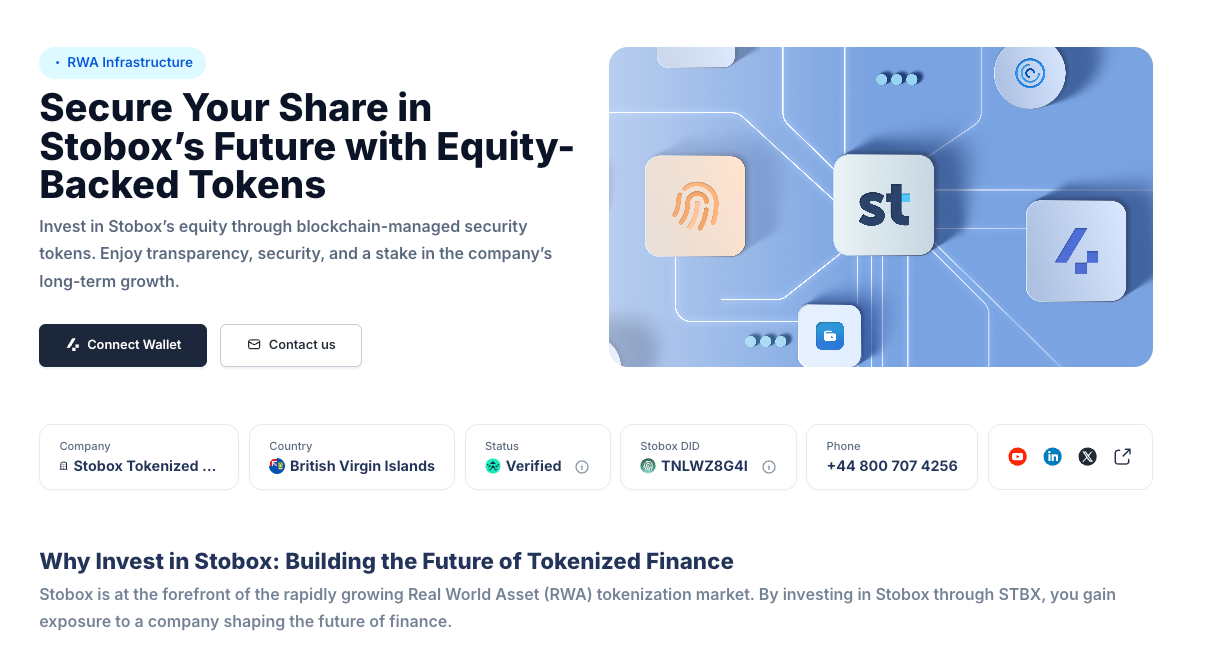
Security tokens are not a marketing upgrade. They are a category shift. A well-structured security token can represent regulated rights tied to an underlying security, such as equity, under a compliant framework. For holders, that changes the nature of the asset. Instead of relying mainly on narrative-driven price appreciation, a holder can own a digital instrument that is explicitly connected to the economic activity of the issuer, subject to the terms, disclosures, and legal protections that securities frameworks are designed to provide.
In that spirit, Stobox is offering the community a path from STBU toward STBX, an equity-backed security token designed to reflect economic interest in Stobox activity.
The goal is not to erase the past or claim that losses did not happen. The goal is to provide a rational option to mitigate the core weakness of utility tokens: they often fail to represent real ownership economics, especially in a market where most buyers are not using tokens for payments in the first place.
Concretely, Stobox has tokenized 20% of Stobox holdings and represented it in the form of a security token available via the Stobox 4 tokenization platform. This is not only a product direction. It is also a credibility direction. In 2026, we plan to promote RWAs not only as a concept for clients but by using our own structure as a working example, demonstrating how tokenization can be applied to real economic instruments under proper compliance.

A major obstacle, however, is education. Most of the crypto market still does not understand security tokens well. Many people hear token and assume it behaves like every other traded asset on an exchange. Security tokens are different: they come with regulated issuance processes, onboarding requirements, and transfer rules. They can also offer a clearer link between the holder and the issuer’s economic reality, precisely because they are designed to sit inside legal and financial frameworks rather than outside them.

That is why we started with a reward program. STBU holders are rewarded with STBX security tokens. This approach helps holders become familiar with what Stobox Security Token is and how it works. In Q1, the next step begins: conversion from STBU to STBX, so that any eligible holder can choose to become a shareholder through a regulated, equity-backed digital asset structure.
It is important to be explicit: this is being done with legal considerations at the center, not as an afterthought. Securities instruments require disciplined handling, including eligibility checks, jurisdiction restrictions, KYC/AML, and the right disclosures. Those constraints may feel less crypto, but that is exactly the point. RWAs and security tokens sit at the intersection of crypto rails and real-world financial rules. If the objective is durable value capture and institutional credibility, that intersection is where the work must be done.
The broader message to the community is simple, even if the transition is complex. The market has shown, repeatedly, that utility tokens can suffer long, deep drawdowns even when the underlying business continues to build. Meanwhile, real clients prefer bank transfers and stablecoins for services, not volatile utility tokens. Stobox is choosing to adapt to that reality by offering a clearer ownership-linked alternative.
STBU remains part of the ecosystem and community. But the forward direction is about giving holders a more economically grounded instrument and positioning Stobox to lead in the RWA era with an example that starts at home.